
AI for Boutique Owners — How to Compete with Amazon in 2026
If you’re a boutique owner staring down Amazon’s same-day delivery, infinite inventory, and algorithmic pricing, the outlook can feel bleak. But here’s what the numbers actually show: AI for boutique owners is quietly reshaping independent retail, and the stores using it are growing faster than the industry average.
A 2025 Shopify report found that independent retailers using AI tools saw a 23% increase in average order value and a 31% improvement in inventory turnover. That’s not about matching Amazon feature-for-feature — it’s about using AI for boutique owners to double down on what big-box retailers can never replicate: curation, community, and personalized service.
This guide covers seven practical AI strategies that boutique owners are deploying right now — with specific tools, realistic budgets, and step-by-step implementation. No enterprise software. No six-figure budgets. Just smart automation that fits the way you already run your shop.
The Amazon Problem Is Real — But It’s Not Unbeatable
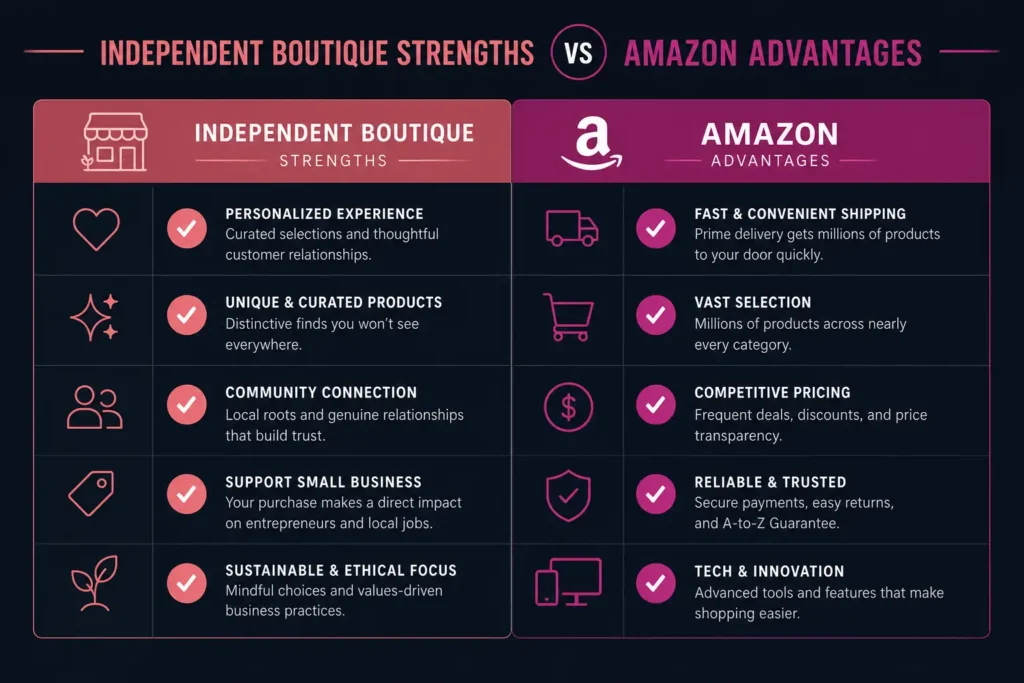
Let’s be honest about the competitive landscape. Amazon controls roughly 38% of U.S. e-commerce. They can undercut you on price, outspend you on shipping, and list ten million products where you list ten thousand. Trying to beat Amazon at their own game is a losing strategy.
But here’s what Amazon cannot do: walk a customer through a curated collection, remember that she prefers earth tones over neons, or text her when a piece arrives that matches the dress she bought last month. AI for boutique owners amplifies exactly these strengths — the human, curated, relationship-driven advantages that make people choose your store over a search bar.
According to a McKinsey personalization study, 71% of consumers expect personalized interactions — and 76% get frustrated when they don’t receive them. Amazon delivers personalization through algorithms. You can deliver it through AI-enhanced relationships that feel genuinely human.
Strategy 1: AI-Powered Product Recommendations That Feel Personal
Why This Matters for Boutique Owners
Amazon’s recommendation engine generates 35% of their total revenue. As a boutique owner, you don’t need an algorithm that complex — but you absolutely need one that works. AI for boutique owners starts here because personalized recommendations directly increase average order value by 15-30%.
How It Works
Tools like Rebuy, LimeSpot, and Nosto integrate with Shopify and WooCommerce to track browsing patterns, purchase history, and style preferences. When a returning customer lands on your site, they see products curated to their taste — not a generic “bestsellers” grid.
In-store, apps like Clientbook let your sales associates pull up a customer’s purchase history on a tablet and make AI-assisted suggestions. “You bought that navy blazer last month — this new chambray shirt pairs perfectly with it.” That’s AI for boutique owners done right: technology powering the human connection, not replacing it.
Setup Cost and Time
Most recommendation tools run $29-$99/month for Shopify. Setup takes 2-3 hours. You’ll see measurable results within 30 days as the algorithm learns your customer base.
Strategy 2: Smart Inventory Forecasting — A Game-Changer for AI for Boutique Owners
The $200,000 Problem
The average boutique ties up 20-30% of revenue in unsold inventory. Markdowns on dead stock eat into margins that are already thin. AI for boutique owners solves this by predicting what will sell, how much to order, and when to reorder — before you’re stuck with 47 units of a trend that peaked two months ago.
How It Works
AI inventory tools analyze your sales history, factor in seasonality, monitor social media trends, and even track weather patterns (warm winters kill coat sales). Platforms like Inventory Planner, Singuli, and Prediko generate purchase orders that optimize for both revenue and cash flow.
One boutique owner in Austin reported cutting deadstock by 40% in her first season using AI-driven forecasting — freeing up $23,000 in cash that she reinvested into a pop-up shop. A 2025 Shopify analysis confirmed that AI-powered inventory tools reduce overstock by 20-40% across retail businesses of all sizes.
Setup Cost and Time
Inventory forecasting tools range from $49-$199/month depending on SKU count. Initial setup requires importing 12+ months of sales data (most tools pull this automatically from Shopify or Square). Allow one full buying cycle (6-8 weeks) for meaningful accuracy.
Strategy 3: Automated Social Media Content
The Content Treadmill
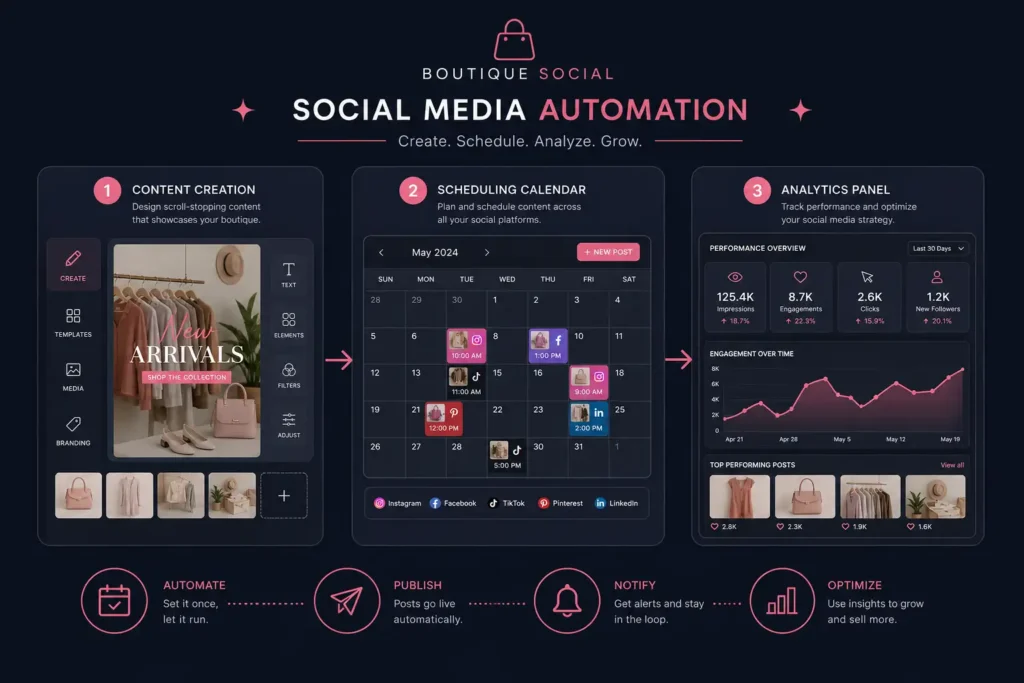
You know the drill: post to Instagram, write a caption, add hashtags, cross-post to Facebook, schedule a TikTok, respond to comments — rinse, repeat, seven days a week. For boutique owners, social media is essential but exhausting. This is where AI for boutique owners delivers the biggest time savings.
How It Works
AI content tools like Lately, Predis.ai, and Canva’s Magic Studio generate social posts from your product photos, write captions that match your brand voice, and schedule everything across platforms. You spend 2 hours on Monday planning the week instead of 1 hour every single day.
The key for boutiques: use AI to generate the 80% of posts that are straightforward (new arrivals, styling tips, promotions), and save your personal energy for the 20% that need your authentic voice (behind-the-scenes, customer stories, trend commentary).
Setup Cost and Time
Most AI social tools cost $19-$49/month. Setup takes 1-2 hours to connect accounts and train the tool on your brand voice. Budget 30 minutes/day for review and approval versus the 60-90 minutes you’re spending now.
Strategy 4: AI Email Marketing That Converts
Why Email Still Wins
Email marketing returns $36 for every $1 spent — the highest ROI of any digital channel. For boutique owners, the problem isn’t knowing email works; it’s finding time to write, segment, and send campaigns consistently. AI for boutique owners makes email marketing nearly effortless.
How It Works
Platforms like Klaviyo, Mailchimp, and Omnisend now include AI features that write subject lines, generate email copy from product photos, segment your list by behavior, and optimize send times per subscriber. A “new arrivals” email that used to take 90 minutes to build takes 15.
The real power is in AI-driven segmentation. Instead of blasting your entire list, AI identifies micro-segments: customers who buy accessories but never shoes, customers who only shop sales, customers who browse weekly but haven’t purchased in 60 days. Each segment gets a tailored message that feels like a personal note.
Results You Can Expect
Boutique owners using AI email personalization report 25-40% higher open rates and 15-20% higher click-through rates compared to generic campaigns. That translates directly to more foot traffic and online orders.
Strategy 5: Dynamic Pricing Without the Race to the Bottom
The Pricing Dilemma
Amazon changes prices 2.5 million times per day. You can’t match that — and you shouldn’t try. But AI for boutique owners can help you price strategically: maximizing margins on hot items, timing markdowns to move slow inventory before it becomes deadstock, and identifying where you’re underpricing products customers would happily pay more for.
How It Works
AI pricing tools like Prisync, Intelligence Node, and even built-in Shopify analytics monitor competitor pricing, analyze your sales velocity, and suggest optimal price points. The goal isn’t to be the cheapest — it’s to be the smartest.
One boutique in Nashville discovered through AI analysis that her handmade jewelry was priced 30% below what the market would bear. A gradual 20% price increase over 8 weeks resulted in zero drop in unit sales and an immediate margin boost.
Setup Cost and Time
Pricing tools range from $29-$199/month depending on SKU volume. Setup takes 3-4 hours for competitor mapping. Run pricing experiments in small batches (10-20 SKUs) before rolling out broadly.
Strategy 6: Visual Search and Style Matching
The Pinterest Effect
Customers walk in with a screenshot from Instagram and say, “Do you have anything like this?” Visual search AI lets your website do the same thing, 24/7. AI for boutique owners now includes visual matching that helps customers find products based on images, not keywords.
How It Works
Tools like Syte, ViSenze, and Google Lens integration allow customers to upload a photo and see matching or similar products from your inventory. This is particularly powerful for fashion, home décor, and accessories — categories where visual browsing drives purchasing decisions.
For in-store use, some boutiques train AI on their current inventory so associates can snap a photo of a customer’s existing piece and pull up complementary items instantly. It’s the digital equivalent of a stylist’s trained eye.

Strategy 7: AI-Enhanced Customer Service
After-Hours Revenue Recovery
When your boutique closes at 6 PM, customer questions don’t stop. AI chatbots handle the after-hours inquiries that would otherwise wait until morning — by which point the customer has already bought from someone else. This application of AI for boutique owners is one of the fastest to show ROI.
How It Works
AI chat tools like Tidio, Gorgias, and Re:amaze provide instant answers about sizing, availability, shipping, and returns. The best implementations train the AI on your specific product knowledge — “Yes, that silk blouse runs one size small; we recommend sizing up” — so responses feel knowledgeable, not generic.
For boutiques with a strong personal brand, the best approach is AI-assisted, not AI-only. Let the chatbot handle the factual questions (store hours, return policy, size charts) and route the relationship-building conversations (styling advice, special requests) to you or your team. As we covered in our guide to AI customer service for small business, the goal is faster support without losing the personal touch.
Results
Boutiques using AI chat report capturing 15-25% more after-hours inquiries that convert to sales. At an average order value of $85, even 10 additional conversions per month adds $850 to your bottom line.
The Complete AI Budget for Boutique Owners
Here’s what a full AI stack costs for a typical boutique doing $300K-$800K in annual revenue:
- Product recommendations: $49/month
- Inventory forecasting: $99/month
- Social media automation: $29/month
- Email marketing (AI features): $45/month
- Pricing intelligence: $79/month
- Customer service chatbot: $39/month
Total: $340/month — roughly $11/day. If these tools help you sell even one additional $85 item per day, you’re 7x-ing your investment. Most boutique owners using AI for boutique owners operations report 3-5x ROI within the first quarter.
You don’t need to adopt all seven strategies at once. Start with the two that address your biggest pain points, measure results for 60 days, then layer in the next tool. Our AI ROI calculator for small business can help you prioritize.
5 Mistakes Boutique Owners Make with AI
Mistake 1: Trying to Be Amazon
You’ll never beat Amazon on price, speed, or selection. AI for boutique owners works best when it amplifies your unique advantages — curation, expertise, community. If your AI strategy makes your store feel more like Amazon, you’re doing it wrong.
Mistake 2: Over-Automating Customer Interactions
Your customers chose you because you’re not a faceless algorithm. Use AI to handle routine tasks and free up time for deeper customer relationships — not to replace the human connection that is your competitive moat.
Mistake 3: Ignoring the Data
AI tools generate valuable data about customer behavior, inventory performance, and pricing elasticity. If you’re not reviewing dashboards weekly, you’re paying for insights you never use. Schedule 30 minutes every Monday morning for AI tool review.
Mistake 4: Launching Everything at Once
Seven new tools in one week means seven tools you barely understand. Roll out one AI solution every 3-4 weeks, master it, then move to the next. Sustainable adoption beats flashy launches every time.
Mistake 5: Skipping the Training
AI tools only perform as well as the data and guidance you give them. Spend time training recommendation engines on your aesthetic, chatbots on your product knowledge, and email tools on your brand voice. An hour of training upfront saves months of mediocre output.
Your 30-Day AI for Boutique Owners Starter Plan
Here’s exactly how to start using AI for boutique owners, even if you’ve never touched these tools before:
Week 1: Audit and Prioritize
- Track how you spend every hour for 5 business days
- Identify your two biggest time sinks from the seven strategies above
- Sign up for free trials of the corresponding tools
Week 2: Set Up Your First AI Tool
- Connect to your Shopify/Square/WooCommerce store
- Import historical data (sales, customer lists, inventory)
- Configure basic settings and brand voice
Week 3: Test and Refine
- Run the tool in parallel with your manual process
- Compare AI suggestions against your instincts
- Adjust settings based on early results
Week 4: Go Live and Measure
- Switch fully to the AI-assisted workflow
- Track time saved, revenue impact, and customer feedback
- Plan your second tool rollout based on results
If you want a more detailed implementation framework, our 90-day AI implementation plan breaks down the process week by week for any small business.
The Bottom Line
Amazon isn’t going away. But AI for boutique owners isn’t about building a better Amazon — it’s about building a better boutique. The seven strategies in this guide help you sell smarter, save time, and deepen the customer relationships that Amazon’s algorithm will never replicate.
The boutique owners winning in 2026 aren’t the ones with the biggest ad budgets or the lowest prices. They’re the ones using AI to do what they’ve always done best — just faster, smarter, and at scale.
Start with one tool this week. Measure the results. Then build from there. The technology is ready. The only question is whether you’ll adopt it before your competitors do.
For more AI strategies tailored to small businesses, explore our complete guide to automating your small business with AI or check out the best AI tools for service businesses.
Ready to put AI to work in your boutique? Our AI Profit Levers Bundle includes 50+ ready-to-use prompt templates, implementation checklists, and ROI calculators designed for small business owners. Get the bundle for $27 →