
AI Receptionist for Plumbers: Stop Losing $40K a Year in Missed Calls
You are under a sink with a wrench in your hand when the phone rings. You cannot answer it. The caller has a burst supply line, a wet floor, and exactly zero patience — so they hang up and dial the next plumber on the list. That single unanswered ring just handed a competitor a $450 job, and possibly a customer for the next decade.
An AI receptionist for plumbers solves that specific problem. It picks up on the first ring, every ring, at 2 p.m. and at 2 a.m. It asks what is wrong, how bad it is, where the property is, and whether water is currently running across the floor. Then it books the job on your calendar or texts you immediately if it is a true emergency.
This guide covers what an AI receptionist actually does for a plumbing business, what the missed calls are costing you right now, what the tools cost, how to configure one so it does not embarrass you, and when a human still beats the software.
What Missed Calls Actually Cost a Plumbing Business
Before the tools, the math. Home service businesses miss a large share of inbound calls simply because the people who answer phones are the people holding the tools. Run your own numbers with this:
| Input | Typical small plumbing shop |
|---|---|
| Inbound calls per week | 40 |
| Percentage missed or sent to voicemail | 25% (10 calls) |
| Percentage of missed callers who never call back | ~80% (8 calls) |
| Percentage of those who would have booked | 25% (2 jobs) |
| Average ticket | $400 |
| Lost revenue per week | $800 |
| Lost revenue per year | $41,600 |
Change any input to match your shop and the conclusion rarely changes: the leak is bigger than the cost of plugging it. An AI receptionist for plumbers typically runs $50–$300 a month. If it captures one extra $400 job a month, it has already paid for itself several times over.
The second cost is slower and worse. Callers who reach voicemail do not just skip you this time — they save the number of whoever did answer. You are not losing a job, you are losing a customer file, plus the water heater replacement two years from now, plus the referral to their neighbor.
What an AI Receptionist for Plumbers Actually Does

Ignore the demos with the fake enthusiasm. Here is the practical job description of an AI receptionist in a plumbing business:
Answers every call on the first ring. No hold music, no phone tree, no “your call is important to us.” Modern voice AI answers in under a second and speaks conversationally.
Qualifies the call. Is this an emergency or a scheduled job? Residential or commercial? Owner or tenant? Inside city limits or out in your extended service area? This is the part that saves you the most time, because it kills the calls you were never going to take.
Triages emergencies. Active flooding, no water in the house, sewage backup, or a gas smell should not sit in a queue. A properly configured AI receptionist recognizes those phrases and escalates — a call, an SMS, or a push to whoever is on rotation.
Books the job. Connected to your scheduling software, it offers real open slots and writes the appointment straight into the calendar with the address and problem description already attached.
Captures the details you always forget to ask. Property address, gate codes, whether they know where the shutoff valve is, whether it is a slab or crawlspace, whether a landlord has to approve the work. Your tech shows up informed instead of guessing.
Sends the follow-up. Confirmation text, appointment reminder, and a review request afterward. Most no-shows are memory problems, not commitment problems.
Never gets sick, quits, or takes lunch. The unglamorous advantage. A part-time receptionist covers about 20 hours a week. The AI covers 168.
What It Does Not Do Well
An honest section, because the vendors will not write it for you.
It does not quote complex work. Let it give a diagnostic fee or a flat trip charge. Do not let it price a repipe or a sewer line over the phone. Configure it to say “our tech will price that on site” and move on.
It struggles with heavy accents, bad cell reception, and background noise. Accuracy on a clean line is excellent. Accuracy on a call from a mechanical room with a compressor running is not. Always keep a “transfer to a human” path.
It cannot calm a genuinely furious customer. A callback complaint about work you already did should route to a person immediately. Build a rule for it.
It sounds worse when you make it pretend to be human. Shops that let the AI open with a fake first name get caught, and the customer feels tricked. “Hi, this is the automated assistant for Riverside Plumbing — I can book you right now or get a tech on the line” performs better and ages better.
How to Set One Up in a Weekend
Budget about four to six hours total. Nobody needs a developer for this.
Step 1: Get a second phone number. Do not repoint your main line on day one. Buy a new number, forward it, and test on real calls before it touches your primary listing.
Step 2: Write your call rules before you touch software. Emergencies, service area boundaries, hours, trip charge, brands you do and do not service, what requires a human. This document is the entire product — the software just reads it out loud.
Step 3: Connect your scheduler. ServiceTitan, Housecall Pro, Jobber, or plain Google Calendar all work. If the AI cannot see real availability, it will double-book you and you will hate it inside a week.
Step 4: Record the escalation rules. Which words trigger a live transfer, which trigger an SMS to the on-call tech, and what happens at 11 p.m. on a Sunday.
Step 5: Call it twenty times yourself. Be a nice customer, an angry customer, a confused customer, a wholesale supplier, and a spam caller. Fix what breaks. Then have your spouse or a tech do the same, because you unconsciously speak to it in the phrasing it expects.
Step 6: Forward the main line after hours only. Run nights and weekends for two weeks. Review every transcript. Then expand to overflow during the day once you trust it.
Use this prompt to draft your call rules before you configure anything:
You are helping me write the call-handling script for an AI receptionist
at my plumbing company.

Business: {business name}
Service area: {cities/radius}
Hours: {hours}
Trip/diagnostic fee: {amount}
Scheduling software: {tool}
Work we do NOT take: {examples}

Write:
1. A greeting under 15 words that states it is an automated assistant.
2. Five qualifying questions in the order they should be asked.
3. A list of caller phrases that indicate a true emergency requiring
   immediate transfer to a human.
4. Exact wording for declining to quote a price over the phone.
5. Exact wording for a caller outside the service area.
6. A confirmation summary the assistant reads back before booking.

Keep every line conversational and under 20 words.
What It Costs
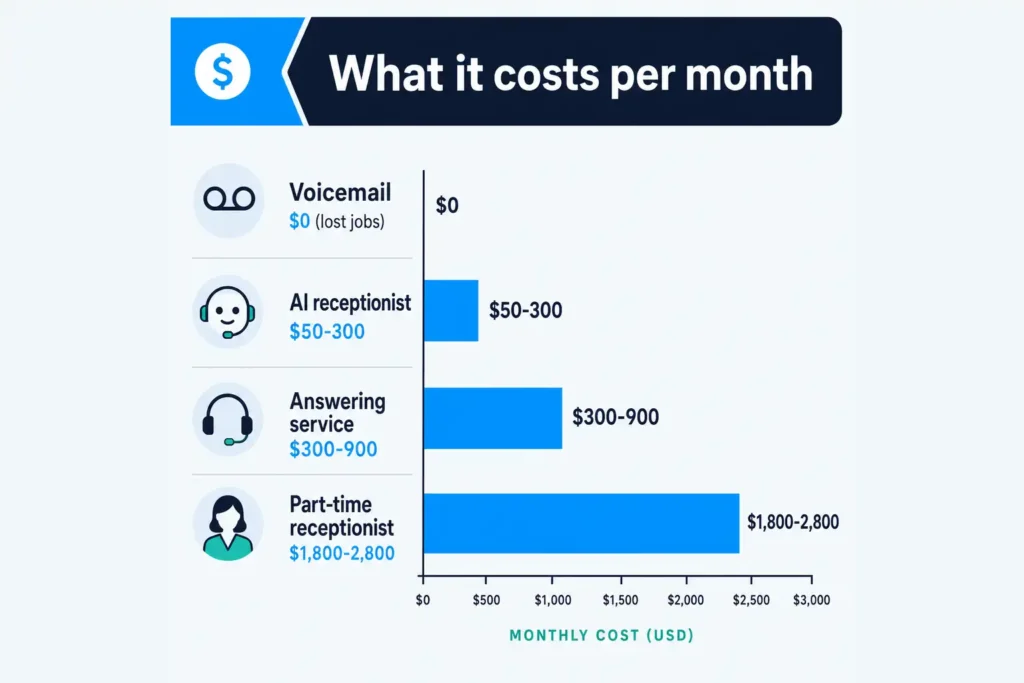
| Option | Monthly cost | Best for |
|---|---|---|
| Generic AI voice agent | $50–$100 | Owner-operator, after-hours coverage only |
| Home-service-specific AI receptionist | $150–$300 | 2–8 trucks, needs scheduler integration |
| Live answering service | $300–$900 | Shops wanting human voices, higher ticket work |
| Part-time human receptionist | $1,800–$2,800 | Established shops with office space |
Watch the per-minute overage charges. Plans advertise a base price and then bill $0.10–$0.25 per minute past an included bundle. Estimate your real call minutes, not your call count — plumbing intake calls run three to five minutes.
The comparison that matters is not AI versus human. It is AI versus voicemail, because voicemail is what is actually answering your phone right now.
How to Choose Between Vendors Without Watching Six Demos
Every vendor in this category shows the same polished demo. Ignore it and ask these seven questions instead. If a rep dodges more than two, move on.
1. Does it write into my scheduler, or only read from it? Read-only integrations mean someone still enters the job by hand. That is half the value gone.
2. What happens when the AI does not understand? The right answer is a live transfer or a callback promise with a captured number — not a loop of “I’m sorry, could you repeat that.”
3. Can I see full transcripts and recordings? Non-negotiable. Without transcripts you cannot improve the script or catch a mishandled emergency.
4. What is the true per-minute rate past the bundle? Get it in writing. Seasonal spikes — a January freeze, a heavy storm week — are exactly when overage bills surprise people.
5. How long does a script change take? You should be able to edit your own rules in minutes. If changes go through a support ticket, you will stop making them.
6. Do you keep my phone number if I leave? Port-out terms matter more than the monthly price. Never let a vendor own your primary business number.
7. Is there a month-to-month plan? Anyone confident in retention will offer one. Twelve-month contracts on brand-new AI products are a bad trade in a category changing this fast.
Two more practical notes. Spam and robocalls will eat your included minutes if you do not enable screening — a busy shop can burn 15% of its bundle on warranty scams and supplier robocalls. And run the AI on a number that forwards, never as your listed number, so a vendor outage never takes your business offline.
Common Questions About Using an AI Receptionist for Plumbers
Will customers know it is AI? Most will, and that is fine. Homeowners care about getting a plumber scheduled, not about who took the message. What they do not forgive is being deceived — so disclose it in the greeting.
What about older customers? They handle it better than expected, because voice AI is easier than a phone tree with seven options. The failure cases are noisy lines and heavy accents, not age.
Can it handle commercial and property management calls? Yes for intake and dispatch, no for anything contract-related. Route known commercial numbers straight to a human — those accounts are worth the interruption.
Do I still need a human answering during the day? If you already have office staff, keep them and use the AI for overflow and after hours. If you are an owner-operator, the AI is your office staff.
What about texts and web form leads? Most tools in this category now handle SMS too, and answering a web form within five minutes is worth as much as answering the phone. Turn that on the same week.
The Numbers to Watch After 30 Days
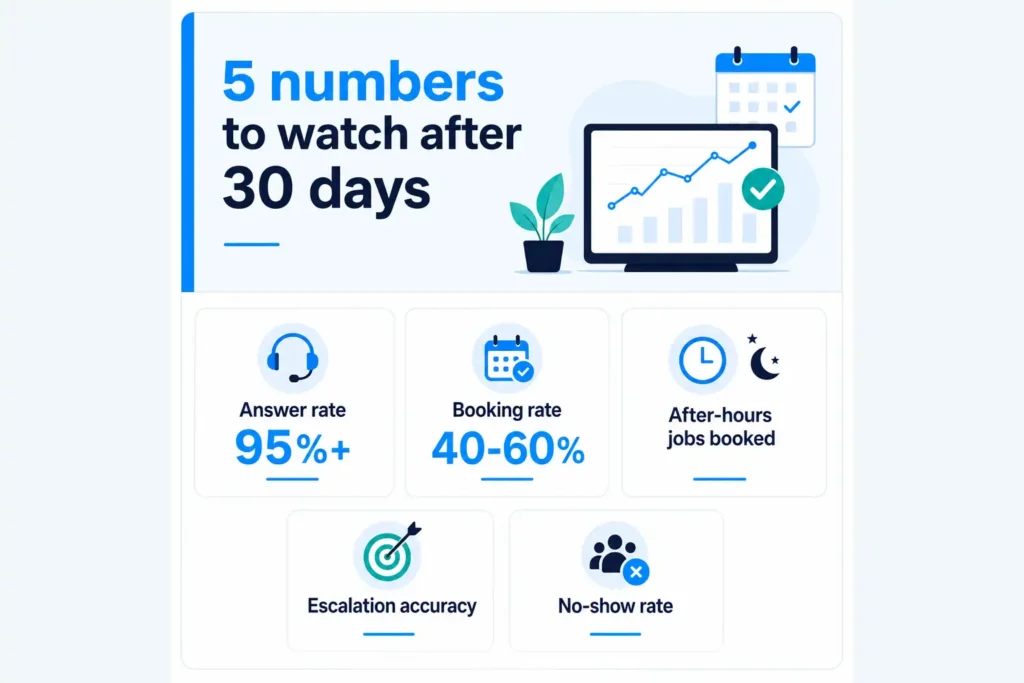
Do not judge this on how the AI sounds. Judge it on five metrics:
1. Answer rate. Should move to 95%+ from wherever you are today. This is the whole point.
2. Booking rate on answered calls. Target 40–60% for inbound service calls. If it is under 25%, your qualifying questions are too long or your first available slot is too far out.
3. After-hours jobs booked. Pure new revenue. These are jobs you previously never heard about.
4. Escalation accuracy. Read transcripts of every call flagged as an emergency, plus a sample that were not. A missed emergency is the one failure mode that genuinely costs you.
5. Cancellation and no-show rate. If it climbs, the AI is booking unqualified callers. Tighten the screening questions.
Review transcripts weekly for the first month. It is dull work and it is where all the improvement comes from — you will find one question phrased badly that is quietly costing you a job a week.
Where This Fits in a Plumbing Shop’s AI Stack
The receptionist is the front door, not the whole house. It pairs naturally with automated dispatch and scheduling, which is covered in our guide to AI scheduling for plumbers, and with the follow-up and review-request side of the business in AI customer service for small business.
If you run HVAC alongside plumbing, the same setup applies with a different question set — see how HVAC companies use AI. For the estimates, invoices, and text templates around the job, the ChatGPT prompts every contractor should use will save you more hours per week than the phone system will. And if you want the full picture of what to automate first, start with the AI prompts for small business owners pillar.
The Bottom Line
An AI receptionist for plumbers is not an efficiency upgrade. It is a leak repair. Every call that goes to voicemail is revenue running down the drain, and unlike most marketing spend, plugging this leak has a payback period measured in days.
Start narrow: after hours only, one new number, twenty test calls, two weeks of transcript review. If it books one job in the first month you are ahead. If it books four, you have found the cheapest hire you will ever make.
The plumber who answers the phone gets the job. It has always been that simple — the only new part is that answering it no longer requires you to put the wrench down.
Want the full playbook for automating the rest of the business? The AI Profit Mastery Bundle includes prompt templates, implementation checklists, and ROI calculators built for owner-operators — get it for $27 →