
60 AI Prompts for Small Business Owners — Copy, Customize, and Profit
The gap between businesses thriving with AI and those still struggling isn’t budget, technical skill, or industry — it’s prompts. The right AI prompts for small business owners are the difference between generic AI output and responses that actually drive revenue.
This is the complete library: 60 AI prompts for small business owners covering marketing, sales, customer service, operations, finance, and hiring. Every prompt is copy-paste ready, tested across ChatGPT, Claude, and Gemini, and written for owners who don’t have time to learn prompt engineering from scratch.
Just replace the {bracketed placeholders} with your own details. Bookmark this page — it’s the only prompt library you’ll need.
How to Use These AI Prompts for Small Business Owners
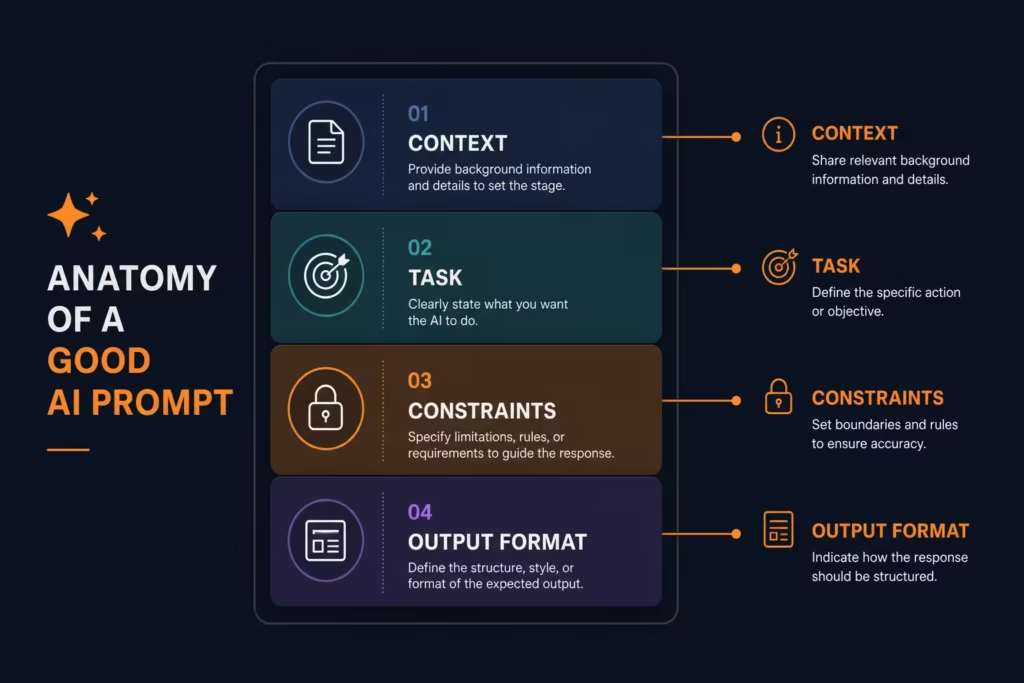
Every prompt below follows the same structure: context → task → constraints → output format. This structure consistently produces better results than vague, one-line prompts.
To customize any prompt, replace the bracketed text {like this} with your specific business details. The more specific you are, the better the output. “I run a business” produces mediocre results. “I run a 3-person HVAC company in Dallas serving residential customers” produces actionable ones.
These AI prompts for small business owners work across all major AI tools. We’ve tested each one on ChatGPT-4, Claude, and Gemini. Minor phrasing differences may produce slightly different outputs across platforms, but all templates work on all three. Research from McKinsey confirms that well-structured prompts can improve AI output quality by 2-3x compared to unstructured requests.
Marketing AI Prompts for Small Business Owners (15 Prompts)
These marketing AI prompts for small business owners cover the content, ad, and SEO work that usually eats a whole afternoon.
1. Social Media Content Calendar
I run {business type} in {location} targeting {audience}. Create a 30-day
social media content calendar for {platform}. Include post topics, suggested
captions under 150 words, best posting times, and relevant hashtags. Mix
educational (40%), promotional (20%), behind-the-scenes (20%), and engagement
posts (20%). My brand voice is {professional/casual/fun/authoritative}.
2. Blog Post Outline
Write a detailed blog post outline for the topic '{topic}' targeting
{audience}. Include: an attention-grabbing H1, 6-8 H2 sections with brief
descriptions, 2-3 H3 subsections per H2, a compelling introduction hook, a
conclusion with CTA, and 5 internal linking opportunities. Target word count:
2,000 words. SEO focus keyword: {keyword}.
3. Email Welcome Sequence
Create a 5-email welcome sequence for new subscribers to my {business type}
email list. Email 1: Welcome and brand story. Email 2: Most popular resource/tip.
Email 3: Customer success story. Email 4: Common problem and solution. Email 5:
Special offer for new subscribers. Each email should be 150-250 words, include
a subject line with 40%+ predicted open rate, and end with a clear CTA. My
audience is {description}.
4. Google Ads Copy
Write 5 Google Ads variations for my {business/service} targeting the keyword
'{keyword}'. For each ad, provide: 3 headline options (max 30 characters each),
2 description options (max 90 characters each), and a display URL path. Focus
on {unique selling proposition}. Include a strong CTA. My competitors' main
claims are {competitor claims}.
5. Customer Testimonial Request
Write 3 different testimonial request emails for {business type} customers who
completed {service/purchase} within the last 30 days. Each version should use a
different angle: Version 1 — straightforward ask, Version 2 — guided questions
to answer, Version 3 — incentive-based (small discount on next service). Keep
each under 100 words. Include specific questions that generate detailed, useful
testimonials.
6. Local SEO Content
Create a location-specific landing page outline for my {business type} serving
{city/area}. Include: a locally-relevant H1 with city name, 5 sections addressing
local customer needs, mentions of local landmarks or neighborhoods, local
statistics or data points, a Google Maps embed suggestion, and a CTA for
{desired action}. Target keyword: '{business type} in {city}'.
7. Video Script
Write a 60-second video script for {platform: TikTok/Instagram Reels/YouTube
Shorts} about {topic} for my {business type}. Include: a hook in the first 3
seconds, 3 key points delivered conversationally, a clear CTA at the end, and
on-screen text suggestions. Tone: {casual/professional/humorous}. Target
audience: {description}.
8. Competitor Analysis
Analyze my competitive position. My business: {description, USP, pricing}. My
top 3 competitors: {names and what you know about them}. For each competitor,
identify: their likely target audience, their main value proposition, gaps in
their offering I can exploit, and messaging angles that differentiate me.
Present as a comparison matrix.
9. Lead Magnet Creation
Design a lead magnet for {business type} targeting {audience}. Give me 5 options
with: title, format (checklist/template/guide/quiz/calculator), outline of
contents, estimated creation time, and the email opt-in page headline. Each
option should solve a specific pain point that naturally leads to my paid
{service/product}.
10. Referral Program Copy
Create copy for a referral program for my {business type}. Include: a program
name, referral email template (customer sends to friend), landing page headline
and subhead, 3 social media posts promoting the program, and terms and conditions
outline. Reward structure: {referrer gets X, referee gets Y}. Keep everything
casual and shareable.
11. Product Description
Write 3 product description variations for {product name}. Variation 1:
Feature-focused (specs, materials, dimensions). Variation 2: Benefit-focused
(what it does for the customer). Variation 3: Story-driven (origin,
craftsmanship, purpose). Each should be 100-150 words, include sensory language, and end with a
micro-CTA. Target customer: {description}.
12. Holiday Campaign Plan
Create a complete marketing campaign plan for {holiday/event} for my
{business type}. Include: campaign timeline (2 weeks before through 1 week
after), daily social posts, 3-email sequence, one special offer with urgency
triggers, ad copy for Facebook and Google, and budget allocation recommendation
for a ${amount} total budget.
13. Brand Voice Guide
Develop a brand voice guide for my {business type}. My brand personality is
{3-4 adjectives}. My audience is {description}. Create: 5 'we say this, not
that' examples, tone guidelines for different channels (email, social, website,
in-person), 10 power words we should use frequently, 10 words we should avoid,
and a sample paragraph demonstrating the voice.
14. Repurposing Strategy
I have a {blog post/podcast episode/video} about {topic}. Create a repurposing
plan that turns this single piece into: 5 social media posts (2 LinkedIn, 2
Instagram, 1 Twitter/X), 1 email newsletter, 3 short-form video scripts (30
seconds each), 1 infographic outline, and 5 quote graphics. Each piece should
stand alone without requiring context from the original.
15. SEO Meta Descriptions
Write meta descriptions for these 10 pages on my {business type} website: {list
pages}. Each meta description must: be between 150-160 characters, include the
primary keyword naturally, contain a clear benefit or value proposition, include
a CTA or curiosity hook, and avoid duplicate phrasing across descriptions.
Sales AI Prompts for Small Business Owners (10 Prompts)
Sales is where AI prompts for small business owners pay back fastest — every template below shortens the path from first contact to signed deal.
16. Cold Outreach Email
Write 3 cold outreach email variations for my {service} targeting {prospect
type}. Each email must: be under 100 words, open with a specific observation
about the prospect's business, state one clear benefit, include social proof
(I've helped {X} businesses achieve {result}), and end with a low-friction CTA
(not 'book a call' — something easier). No generic flattery.
17. Sales Call Prep
I have a sales call with {prospect description — industry, size, what they
mentioned}. Help me prepare: 5 discovery questions to understand their pain
points, 3 ways to position my {service} as the solution, 2 potential objections
and responses, a pricing presentation strategy, and a suggested next step after
the call.
18. Proposal Template
Create a proposal template for my {service} targeting {client type}. Include
sections for: executive summary (their problem, my solution, expected results),
scope of work with deliverables and timeline, pricing with 3 tier options
(good/better/best), case study summary, terms and next steps. Keep the tone
confident but not salesy. Total length: 2 pages max.
19. Follow-Up Sequence
Write a 5-touchpoint follow-up sequence for prospects who received my proposal
but haven't responded. Touch 1 (Day 3): Gentle check-in. Touch 2 (Day 7): Share
a relevant resource. Touch 3 (Day 14): Address a common concern. Touch 4 (Day 21):
 Create urgency (limited availability/pricing). Touch 5 (Day 30): Graceful close.
Each touch under 75 words.
20. Objection Handling Guide
List the 10 most common objections for a {service type} business and write
responses for each. Format: Objection → Acknowledge → Reframe → Evidence →
Question. Common objections likely include: too expensive, bad timing, need to
think about it, already have a solution, doesn't apply to my industry. My
service costs {price} and delivers {key benefit}.
21. Case Study Framework
Turn these raw notes into a compelling case study: Client: {description}.
Problem: {what they struggled with}. Solution: {what we did}. Results: {metrics
and outcomes}. Format it as: a 50-word summary for the website, a 200-word
version for proposals, and a 500-word version for the blog. Include pull quotes
and data callouts.
22. Upsell/Cross-sell Script
Create upsell talking points for my {service} clients. Current service: {what
they have}. Upsell options: {additional services}. For each upsell, provide:
the transition phrase from current service discussion, the specific problem it
solves, a ROI statement, and the exact words to present pricing without making
it awkward.
23. Discovery Questionnaire
Create a pre-call discovery questionnaire for potential {service} clients.
Include 8-10 questions that: reveal their current situation, uncover hidden pain
points, establish budget expectations, identify decision-making timeline, and
help me customize my pitch. Mix multiple-choice and open-ended. Keep it under 5
minutes to complete.
24. Networking Follow-Up
Write 3 follow-up email templates for people I met at a {type of event}.
Template 1: For someone who expressed interest in my {service}. Template 2:
For a potential referral partner. Template 3: For someone I'd like to learn
from. Each should reference the event specifically, be under 100 words, and
suggest a concrete next step.
25. Pricing Page Copy
Write pricing page copy for my {service} with 3 tiers. Tier 1: {name, price,
features}. Tier 2: {name, price, features}. Tier 3: {name, price, features}.
For each tier: write a one-line description of who it's for, list features with
benefit-oriented descriptions (not just feature names), and highlight the
recommended tier. Include a FAQ section with 5 pricing questions.
Customer Service AI Prompts for Small Business Owners (8 Prompts)
Use these to respond faster without sounding like a robot. Good AI prompts for small business owners protect your tone while saving the typing.
26. FAQ Generator
Generate 20 frequently asked questions and answers for my {business type}.
Organize into categories: Getting Started, Pricing, Service Details,
Troubleshooting, and Policies. Each answer should be 2-3 sentences max, use
simple language, and end with a next step or link suggestion. Write in
first-person plural (we/our).
27. Customer Complaint Response
Write 5 customer complaint response templates for common issues in {industry}.
Issue types: {list 5 common complaints}. Each response should: acknowledge the
frustration without being defensive, take responsibility without admitting fault,
offer a specific resolution, include a timeline for follow-up, and end with a
retention offer. Tone: empathetic and professional.
28. Review Response Templates
Create response templates for online reviews of my {business type}. Write 3
responses for 5-star reviews (vary the language), 3 for 3-4 star reviews
(acknowledge and improve), and 3 for 1-2 star reviews (resolve and recover).
Each should: use the reviewer's name, reference specific details they mentioned,
be under 100 words, and avoid copy-paste feeling.
29. Chatbot Script
Design a chatbot conversation flow for my {business type} website. Cover these
intents: greeting, business hours/location, pricing inquiry, booking/scheduling,
product/service questions, complaint, and human handoff. For each intent,
provide: trigger phrases (5+ variations), bot response, follow-up question, and
escalation criteria. Include a personality (friendly, helpful, slightly
informal).
30. Onboarding Email Series
Write a 4-email onboarding series for new {service} clients. Email 1 (Day 0):
Welcome and what to expect. Email 2 (Day 2): Getting started guide. Email 3
(Day 7): Check-in and tips. Email 4 (Day 14): Feedback request and next steps.
Each email: 150-200 words, includes one helpful resource or tip, and reinforces
why they made a good decision.
31. Service Recovery Protocol
Create a service recovery protocol for my {business type} when things go wrong.
Scenario: {describe a service failure}. Write: the immediate acknowledgment
script (phone and email versions), the investigation update template, the
resolution offer (3 options from minimum to maximum gesture), the follow-up
message 48 hours later, and the internal debrief questions.
32. Customer Survey
Design a post-{service/purchase} survey for my {business type} customers.
Include: 8-10 questions mixing rating scales (1-5), multiple choice, and 2
open-ended questions. Cover: overall satisfaction, specific service aspects,
likelihood to recommend (NPS), and improvement suggestions. Write the survey
invitation email (under 75 words) and a thank-you message with a small incentive.
33. Knowledge Base Article
Write a knowledge base article for my {business type} customers on the topic:
{topic}. Include: a clear title, a one-paragraph summary, step-by-step
instructions with screenshots placeholders, a troubleshooting section with 3
common issues, and related articles suggestions. Reading level: 8th grade.
Length: 400-600 words.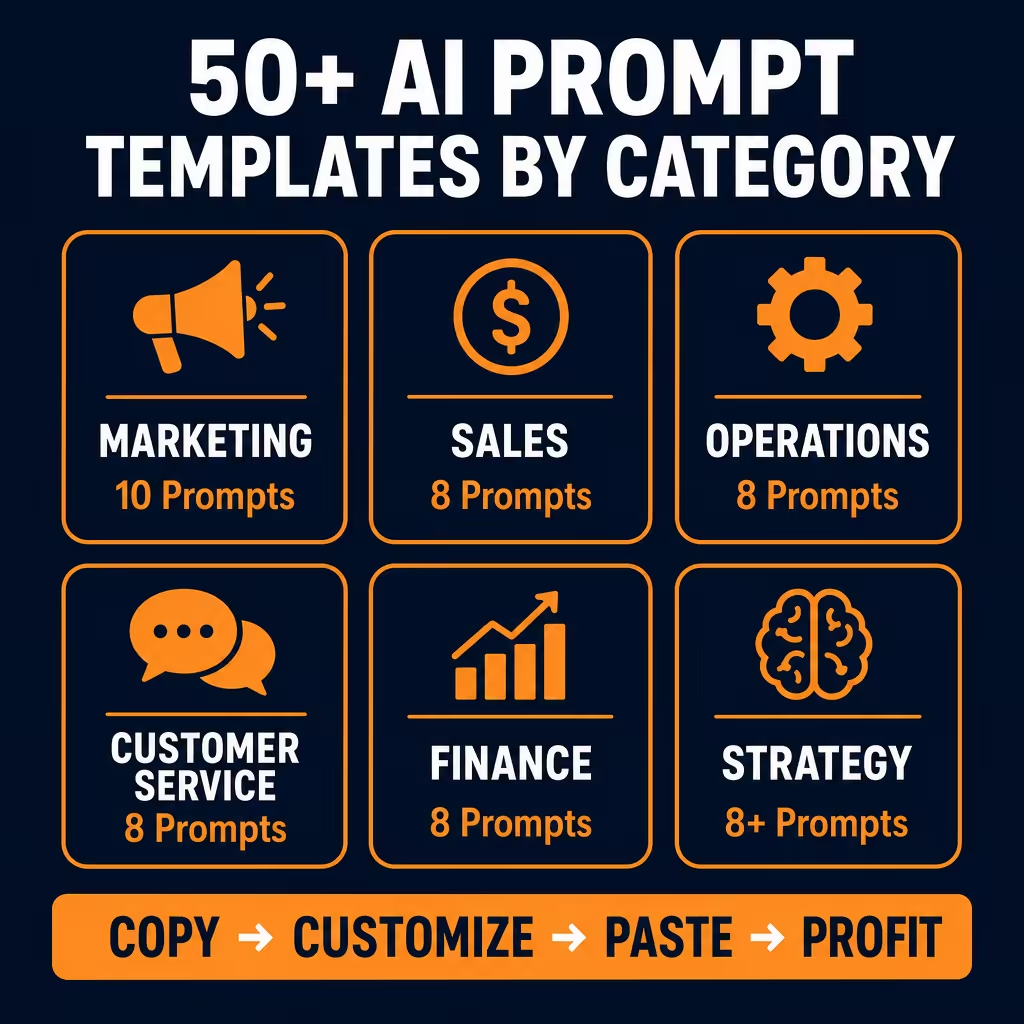
Operations AI Prompts for Small Business Owners (8 Prompts)
Operations prompts are the least glamorous and the highest leverage. These AI prompts for small business owners turn tribal knowledge into documented process.
34. SOP Generator
Create a Standard Operating Procedure for {task/process} in my {business type}.
Include: purpose and scope, roles responsible, step-by-step instructions
(numbered), quality checkpoints, estimated time per step, common errors and how
to avoid them, and a revision log template. Write for a new employee who has
never done this task before.
35. Meeting Agenda and Notes
Create a meeting agenda template for my {weekly team/client/sales} meeting.
Include: pre-meeting prep checklist (3 items), timed agenda with 5-6 topics
(total 45 minutes), discussion prompts for each topic, a decisions/action items
section, and a post-meeting summary template. Also write a follow-up email
template that summarizes decisions and assigns action items with deadlines.
36. Project Timeline
Build a project timeline for {project description}. Duration: {timeframe}.
Team: {number of people and roles}. Break it into phases with: phase name, key
deliverables, task list with estimated hours, dependencies between tasks,
milestones and checkpoints, and risk factors per phase. Format as a table I can
paste into a spreadsheet.
37. Vendor Evaluation
Create a vendor evaluation framework for selecting a {type of vendor/tool} for
my {business type}. Include: 10 evaluation criteria weighted by importance, a
scoring rubric (1-5) for each criterion, 5 questions to ask each vendor, red
flags to watch for, and a decision matrix template. My priorities are: {list 3
priorities}.
38. Process Automation Audit
Audit my business processes for automation opportunities. My business:
{description}. Key processes: {list 5-10 daily/weekly tasks}. For each process,
evaluate: current time spent, automation feasibility (high/medium/low),
recommended tool, estimated setup time, estimated time savings per week, and
implementation priority (1-5). Present as a prioritized action plan.
39. Inventory Management
Create an inventory management system for my {business type} with {number} SKUs.
Include: a reorder point formula based on my average sales velocity, a par level
calculation worksheet, a weekly inventory check template, supplier contact and
lead time tracker, and seasonal adjustment guidelines. My busiest months are
{months} and slowest are {months}.
40. Quality Control Checklist
Design a quality control checklist for {product/service} in my {business type}.
Include: 15-20 checkpoint items organized by production/service stage, pass/fail
criteria for each item, escalation procedures for failures, a daily QC log
template, and monthly trend analysis questions. Keep it simple enough for any
team member to use without training.
41. Crisis Communication Plan
Create a crisis communication plan for my {business type}. Cover 3 scenarios:
{scenario 1, scenario 2, scenario 3}. For each scenario, provide: immediate
internal notification template, customer communication within 1 hour, social
media holding statement, detailed update at 24 hours, and resolution announcement.
Include a decision tree for who approves what communications.
Finance AI Prompts for Small Business Owners (5 Prompts)
You don’t need to be an accountant. These finance AI prompts for small business owners turn raw numbers into decisions.
42. Cash Flow Forecast
Build a 90-day cash flow forecast template for my {business type}. Monthly
revenue: approximately ${amount}. Major recurring expenses: {list}. Variable
costs: {list}. Include: weekly cash position tracker, accounts receivable aging
follow-up triggers, seasonal adjustment factors, a 'danger zone' alert threshold,
and 3 scenarios (optimistic/expected/pessimistic) with different revenue
assumptions.
43. Pricing Strategy Analysis
Analyze my pricing strategy for {product/service}. Current price: ${amount}.
Cost to deliver: ${amount}. Competitor range: ${low}-${high}. Market position:
{premium/mid-range/budget}. Provide: margin analysis, price elasticity estimate,
3 pricing model options (flat rate, tiered, value-based) with pros and cons, a
price increase communication template, and a discounting policy framework.
44. Monthly Financial Review
Create a monthly financial review template for my {business type}. Include: key
metrics dashboard (10 numbers I should track), month-over-month comparison
framework, variance analysis template (why actual differed from budget), 5
questions to ask myself about the numbers, and a 3-sentence executive summary
template for each month. Keep it simple as I'm not an accountant.
45. Tax Deduction Tracker
Create a tax deduction tracking system for my {business type}. Include: common
deduction categories for {industry}, a weekly expense logging template, receipt
organization system, quarterly estimated tax calculation guide, and year-end
preparation checklist. Note: this is for organization only — I'll verify
deductions with my accountant.
46. Budget Template
Create an annual budget template for my {business type} with ${revenue} in
annual revenue. Include: revenue projections by month (with seasonal adjustments
for {industry}), fixed costs breakdown, variable costs as percentage of revenue,
marketing budget allocation (recommended % by channel), a contingency fund
calculation, and quarterly review checkpoints.
Hiring and HR AI Prompts for Small Business Owners (5 Prompts)
Hiring is expensive to get wrong. These AI prompts for small business owners help you write, screen, and onboard with a real process behind it.
47. Job Description
Write a job description for a {role} at my {business type}. Include: a
compelling opening paragraph (why this role matters), 8-10 responsibilities, 5
required qualifications and 3 preferred qualifications, company culture
description, compensation range: ${range}, and benefits. Write it to attract
{type of candidate} and stand out from generic postings. Avoid jargon and
buzzwords.
48. Interview Questions
Create an interview guide for a {role} at my {business type}. Include: 5
behavioral questions with what-to-listen-for notes, 3 situational questions
specific to {industry}, 2 culture-fit questions, a skills assessment task
(15 minutes), and a scoring rubric. Also write 3 questions the candidate should
ask us (and ideal responses).
49. Employee Handbook Sections
Write the following employee handbook sections for my {business type} with
{number} employees: PTO policy (suggest a competitive structure), remote work
policy, expense reimbursement process, communication expectations (response
times, tools), and performance review framework. Keep language clear, avoid
legalese, and note where I should have an attorney review.
50. Performance Review Framework
Create a quarterly performance review template for {role type} at my {business
type}. Include: 5 KPIs with measurement criteria, a self-assessment section (4
questions), a manager assessment section (4 questions), a development goals
section with SMART goal template, and a conversation guide (what to say, what
to avoid). Total review time: 30 minutes.
51. Onboarding Plan
Design a 30-day onboarding plan for a new {role} at my {business type}. Week 1:
orientation and setup. Week 2: shadowing and training. Week 3: supervised
practice. Week 4: independent work with check-ins. For each week, include: daily
tasks and learning objectives, who they should meet with, resources to review,
and a check-in question for the manager.
Bonus: 9 More AI Prompts for Small Business Owners
These nine AI prompts for small business owners don’t fit neatly into a single department, but they’re some of the highest-leverage prompts in the library. Use them for the recurring thinking work most owners never get around to.
52. Email Subject Line Generator
You are an email marketing expert. Generate 10 subject lines for an email about
{topic — e.g., our summer HVAC maintenance special}. Each subject line must be
under 55 characters, create urgency or curiosity, and be appropriate for {your
audience}. Avoid spam trigger words. Rank them from most likely to get opened to
least.
53. Google Business Profile Description
Write a Google Business Profile description for {business name}, a {business
type} located in {city, state}. We specialize in {top 3 services}. Our ideal
customers are {target audience}. Keep it under 750 characters. Include natural
mentions of {city} and {key service terms} for local SEO. Tone: professional
and welcoming.
54. Appointment Reminder
Write 3 appointment reminder templates for {business type}: one for 48 hours
before, one for 24 hours before, and one for 2 hours before. Include the
appointment details as placeholders. Keep each under 50 words. Friendly but
professional. Include any prep instructions the customer should know about
{service type}.
55. Employee Training Outline
Create a training outline for teaching {topic — e.g., our new CRM system,
customer greeting protocol, safety procedures} to {audience — e.g., new hires,
existing team}. Structure: 3-5 training modules, each with learning objectives,
key points to cover, a practice exercise, and estimated duration. Total training
should take approximately {timeframe}.
56. Revenue Goal Breakdown
I want to reach {revenue goal — e.g., $200,000} in annual revenue for my {business
type}. My average transaction value is {amount} and my average customer makes
{number} purchases per year. Break down: how many customers I need, how many
leads I need (assuming a {X}% conversion rate), and how many marketing
touchpoints that requires per month. Create a monthly target table.
57. Team Recognition Message
Write a personalized recognition message for {employee name} who {specific
achievement — e.g., landed our biggest client this quarter, resolved a difficult
customer situation, consistently showed up early for 3 months straight}. Make it
genuine and specific — not generic praise. Include how their work impacted the
team or business. Under 100 words. Suitable for {delivery method — e.g., team
meeting, company email, Slack message}.
58. The Weekly CEO Brief
You are my virtual chief of staff. Based on the following information about my
week — {paste your notes, wins, challenges, upcoming tasks} — give me a
structured weekly brief. Include: top 3 wins to celebrate, top 3 priorities
for next week, one risk or blind spot to watch, and one strategic idea to
explore. Keep it to one page.
59. The Customer Persona Builder
Build a detailed customer persona for {business name}, a {business type}. Our
best customers are typically {describe loosely — age range, location, situation}.
Create a complete persona including: demographics, psychographics (fears, goals,
frustrations), where they spend time online, what triggers them to buy {your
product/service}, and their biggest objection. Give the persona a name and make
it feel like a real person.
60. The 90-Day Growth Plan
You are a business growth consultant. I own {business name}, a {business type}
in {location} with {number} employees. Current monthly revenue: {amount}. My
goal for the next 90 days: {specific goal — e.g., increase revenue by 25%, add
50 new customers, launch a new service}. Create a specific 90-day action plan
broken into monthly phases with weekly milestones, required resources, and
success metrics.
5 Power Tips for Better AI Prompt Results
Tip 1: Always Provide Context First
Context is the single biggest multiplier on any prompt. Before giving the AI a task, tell it who you are, who your customer is, and what you’re trying to achieve. AI prompts for small business owners work 3x better when the AI understands your business context. Start every session with a brief business overview.
Tip 2: Ask for Multiple Options
Never settle for the first output. The best AI prompts for small business owners are the ones you run twice. Ask for “3 variations” or “5 different angles.” The best output is usually version 2 or 3 — and comparing options helps you refine your instincts about what works.
Tip 3: Use “Act As” Framing
Telling the AI to “act as a {specific expert}” dramatically changes the quality and specificity of responses. “Act as a retail merchandising consultant with 15 years of experience” produces very different advice than a generic request. The more specific the role, the better the output.
Tip 4: Build Prompt Chains
Complex tasks work better as 2-3 connected prompts than one massive prompt. First prompt: research. Second prompt: draft. Third prompt: refine. Prompt chains let you course-correct between steps and produce higher-quality final output.
Tip 5: Save Your Winners
When a prompt produces great results, save it exactly as written. Build a personal prompt library organized by use case. Over time, your library of AI prompts for small business owners becomes a genuine competitive advantage — a system that produces consistent, high-quality output every time. For more practical prompts you can use immediately, check out our ChatGPT starter guide for small business owners.
Common Prompt Mistakes to Avoid
Even the best AI prompts for small business owners fail if you make these four mistakes.
Being too vague. “Write marketing content” produces garbage. “Write a 200-word Instagram caption promoting our summer HVAC maintenance special for homeowners in Dallas, emphasizing the $89 tune-up price and the risk of breakdowns in July heat” produces gold.
Not iterating. AI prompts are conversations, not commands. If the first output isn’t right, refine the prompt — add constraints, change the angle, provide examples of what you want. Two rounds of refinement beats rewriting from scratch.
Ignoring output format. If you need a bulleted list, say so. If you need a table, specify columns. If you need something under 100 words, set the limit. These AI prompts for small business owners include format specifications for exactly this reason — it eliminates 90% of “that’s not what I meant” moments.
Forgetting to fact-check. AI generates confident-sounding text that is sometimes wrong. A Harvard Business Review analysis found that AI hallucination rates vary from 3-27% depending on the complexity of the task. Always verify statistics, legal claims, and technical specifications before publishing. Use AI for the draft; use your expertise for the final check.
The Bottom Line
These 60 AI prompts for small business owners aren’t just a reference library — they’re a productivity system. Every prompt is designed to produce output that’s 80-90% ready to use, cutting hours of work down to minutes.
The business owners who win with AI in 2026 aren’t the ones with the fanciest tools. They’re the ones with the best prompts — the ones who know exactly how to ask for what they need and get usable output on the first try.
Start with the 3-5 AI prompts for small business owners most relevant to your biggest time sinks this week. Customize the bracketed sections, run them, and save the results. Then come back for the next batch. Within 30 days, you’ll have a personalized AI workflow that saves you 10+ hours every week.
Questions Owners Ask About AI Prompts
What makes a good AI prompt for business tasks?
Four things, in this order: the role you want the AI to take, the specific business context (your trade, your city, your price point), the exact output format you need, and the constraints. “Write me a marketing email” gets you generic filler. “You are a copywriter for a residential plumbing company in Cleveland. Write a 120-word email to past customers offering a $89 drain inspection. Friendly, no exclamation marks, one call to action” gets you something you can send. Context is what separates a usable prompt from a useless one.
Do I need prompt templates, or can I just ask normally?
For a one-off question, ask normally. Templates matter when you do the same task repeatedly — weekly social posts, estimate follow-ups, review responses — because a saved template with {braces} for the variable parts gives you the same quality every time instead of re-explaining your business from scratch. The practical test: if you have typed roughly the same request three times, turn it into a template.
What are the best AI prompts for starting a business?
The high-value ones are not the “write my business plan” prompts. They are the ones that pressure-test your idea before you spend money: ask the AI to argue against your pricing, to list the five reasons a customer would choose a competitor, to draft the objections you will hear on a sales call, and to build a break-even calculation from your real numbers. Use AI to find the holes early — that is worth more than a polished plan document nobody reads.
How do I organize my business prompts so I actually use them?
One document, grouped by job to be done — Sales, Marketing, Admin, Customer Service — with each prompt saved exactly as it worked, including the context paragraph. Most owners lose their good prompts in chat history and rewrite them badly a month later. A plain doc or a note on your phone beats any dedicated tool, because the only prompt library that works is the one you can open in ten seconds while you are standing in a driveway.
Can I reuse prompts written for a different industry?
Yes, and it is the fastest way to build a library. The structure of a good estimate-follow-up prompt is identical for a plumber, a landscaper, and a dentist — only the trade, the ticket size, and the objections change. Swap those three variables and keep everything else. That is precisely why the prompts here use {braces}: they are meant to be edited, not admired.
Why does the AI give me generic answers even with a detailed prompt?
Almost always because you asked for too much at once. A prompt that requests a strategy, three emails, and a social calendar in one shot returns shallow versions of all three. Ask for one deliverable, react to it, then ask for the next. The second reason is missing constraints — without a word count, a tone, and a “do not do X,” the AI defaults to safe, average, forgettable output.
Ready to Go Deeper?
These 60 AI prompts for small business owners cover the essentials. But if you want the complete system — advanced prompt chains, industry-specific templates, and the strategy behind building AI into every part of your business — the AI Profit Mastery Bundle gives you everything in one place.
Four expert guides covering AI profit strategies, advanced prompt engineering, common mistakes, and fail-proof workflows — all for just $27.
👉 Get the AI Profit Bundle → $27
Stop staring at the blank screen. Start prompting like a pro.